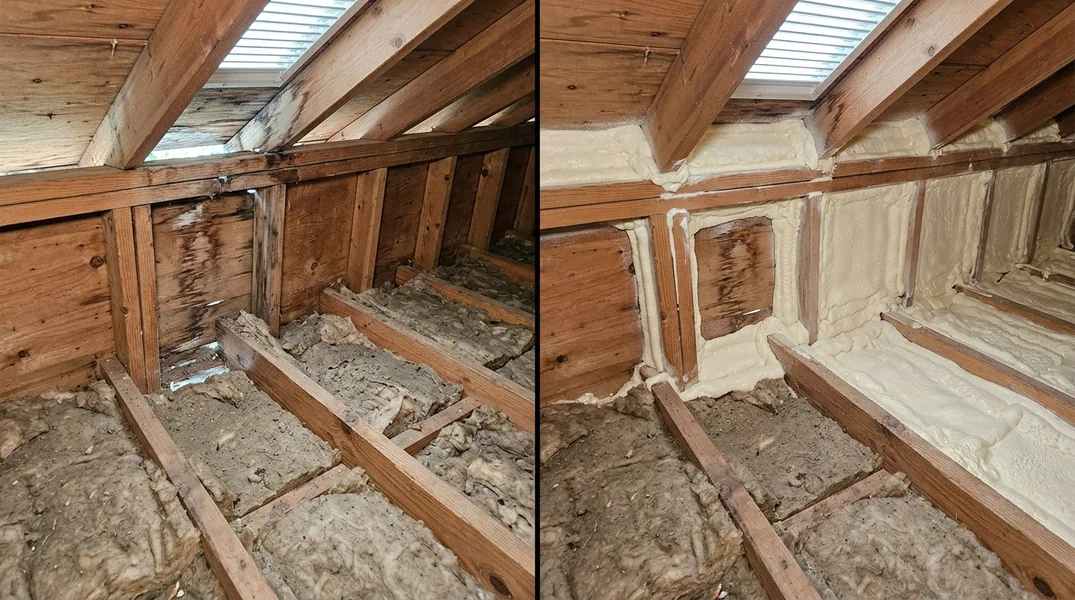
Understanding the Difference: Air Sealing vs. Full Spray Foam
When homeowners in Jacksonville start thinking about improving their attic insulation, they often face a critical decision: should they invest in air sealing alone, or commit to a full spray foam installation? The answer depends on your home's current condition, your energy goals, and your budget.
Air sealing focuses on closing gaps, cracks, and penetrations where conditioned air escapes. Think of it as patching the holes in your thermal envelope. A full spray foam job, on the other hand, provides both air sealing and insulation in one application. Attic Spray Foam Insulation creates a continuous barrier that blocks air movement while simultaneously adding R-value. For many homes, the real question isn't which is better in isolation, but which combination delivers the best return on investment for your specific situation.
What Are the R-Value Requirements for North Carolina Homes?
North Carolina's building codes specify minimum insulation requirements based on climate zone. Jacksonville falls in a moderate climate zone that typically requires R-30 to R-49 in attic spaces, depending on the specific code edition your home was built under. However, meeting the minimum code requirement doesn't necessarily mean your home is optimally insulated or energy efficient.
The spray foam insulation R value per inch varies significantly by foam type. Closed Cell Spray Foam Insulation delivers approximately 6.0 to 6.5 R-value per inch, making it highly efficient for tight spaces. Open Cell Spray Foam Insulation provides around 3.5 to 3.6 R-value per inch, offering a more budget-friendly option that still outperforms traditional fiberglass batts. To meet R-49 with closed cell foam, you'd need roughly 7.5 to 8 inches, while open cell would require 13 to 14 inches. Understanding R value requirements by state helps you avoid over-investing or under-insulating your home.
How Thick Should Spray Foam Be in Your Attic?
The question of thickness directly ties to your climate, current insulation, and energy efficiency goals. How thick should spray foam be isn't a one-size-fits-all answer, but several factors guide the decision. If you're starting from an uninsulated attic, you'll need more foam than if you're topping off existing insulation. Most homeowners benefit from 4 to 8 inches of closed cell foam or 6 to 14 inches of open cell foam, depending on desired R-value and budget.
Another consideration is the air sealing benefit. Even a modest 2 to 3 inch layer of spray foam provides exceptional air sealing properties that fiberglass cannot match. This means that sometimes a partial foam application combined with strategic air sealing can outperform traditional insulation in terms of actual energy savings, even if the R-value number looks lower on paper. The continuous seal prevents thermal bypassing, where warm or cool air escapes through gaps that fiberglass batts simply cannot block.
The Case for Air Sealing First: Strategic Efficiency
Some homes benefit tremendously from targeted air sealing before any foam application. If your attic has obvious air leaks around penetrations, ductwork, electrical conduits, and chimney chases, sealing these first makes economic sense. Air sealing typically costs less per square foot than foam and can reduce energy loss by 10 to 20 percent in homes with significant leakage problems.
However, air sealing alone has limitations. It stops air movement but adds no insulation value. In Jacksonville, where summer cooling demands are substantial, you need both air sealing and adequate insulation to keep your home comfortable and your utility bills reasonable. If your current insulation is thin or degraded, air sealing without adding R-value won't solve the problem. This is why many professionals recommend a combined approach: seal the major air leaks, then add insulation (foam or otherwise) to meet code requirements and your comfort goals.
Full Spray Foam Jobs: When They Make Sense
A full Attic Spray Foam Insulation installation becomes the clear choice when you want a comprehensive, long-term solution. Spray foam adheres to all surfaces, seals every gap simultaneously, and provides insulation in one application. It doesn't settle or compress over time like fiberglass, meaning your R-value remains constant for decades. For homeowners planning to stay in their homes long-term or looking to maximize resale value, the upfront investment in full foam coverage pays dividends.
Full foam jobs also make sense if you have existing moisture problems, vented crawl spaces, or complex attic geometries that make traditional insulation difficult. Spray foam conforms to rafters, joists, and irregular surfaces. Additionally, if you're considering Wall & Injection Foam Insulation for exterior walls or rim joists, completing the attic with spray foam creates a unified thermal envelope that performs better than piecemeal approaches.
Tax Credits and Rebates: Making Your Investment More Affordable
The federal government and many states offer incentives to homeowners who improve their insulation. An insulation tax credit can offset a portion of your spray foam costs. For 2024 and 2025, homeowners may qualify for a 30% tax credit on eligible insulation improvements, up to certain annual limits. This can translate to thousands of dollars in savings on a full attic spray foam project.
Beyond federal credits, check for insulation rebates offered by your local utility company or state energy office. Many utilities provide rebates specifically for attic insulation upgrades because they reduce peak energy demand. When evaluating the pricing of a spray foam project, always factor in available tax credits and rebates. What seems expensive upfront becomes much more affordable when you subtract federal incentives and utility rebates. Contact Jacksonville Spray Foam Insulation at (910) 554-3447 to discuss which credits and rebates you may qualify for based on your specific project.
Making Your Decision: What Jacksonville Homes Actually Need
The truth is that most Jacksonville homes benefit from a combination approach tailored to their unique circumstances. A home with minimal air leaks and adequate existing insulation might only need air sealing and a top-up of foam. A home with poor insulation, visible air leaks, and high energy bills almost certainly needs a full spray foam installation to achieve long-term comfort and efficiency.
The best way to know what your home actually needs is to get a professional assessment. A qualified contractor can evaluate your current insulation levels, identify air leaks, review your energy bills, and recommend a solution that balances performance with budget. Jacksonville Spray Foam Insulation offers a free estimate that includes a thorough evaluation of your attic. We'll explain the R-value requirements for your home, discuss how thick your spray foam should be, and help you understand the true cost of different approaches, including available tax credits and rebates. Call (910) 554-3447 today to schedule your consultation and take the first step toward a more efficient, comfortable home.
Looking for a professional spray foam insulation contractor in Jacksonville? Jacksonville Spray Foam Insulation responds fast for all your spray foam insulation needs.
Get a Free Quote