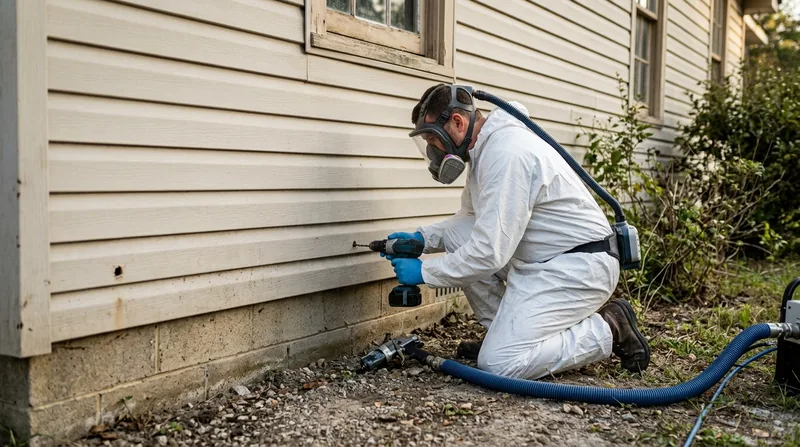




Wall & Injection Foam Insulation in Jacksonville fills the closed cavities of older homes without opening drywall, a critical advantage for the pre-1980 housing stock that dominates downtown and spreads across Onslow County toward Hubert and Sneads Ferry. Jacksonville's humid subtropical climate drives moisture inward through exterior walls during summer, and vented crawl spaces under many of these homes pull in damp coastal air that settles into rim areas and knee walls. Injection foam seals these cavities from the inside, stopping air leakage and thermal loss without the disruption of full wall deconstruction. The method works especially well on rim joists and crawl space perimeter walls where damp air and temperature swings cause the most energy waste and comfort loss. If your home was built in the 1970s or 1980s and sits on a vented crawl space or has uninsulated rim areas, injection foam is often the fastest and most practical retrofit path. Call us at (910) 554-3447 for a free estimate, or explore how crawl space spray foam insulation pairs with wall injection work to seal your entire foundation perimeter.
Why Wall Injection Foam Matters in Jacksonville's Older Housing Stock
Jacksonville's residential core grew up around the military presence, with most homes built from the 1970s onward in single-story ranches and two-story subdivisions that stretch from downtown toward Richlands, Swansboro, and the Crystal Coast. These homes were framed with standard 2x4 exterior walls and often left uninsulated or filled with fiberglass batts that have settled, compressed, or never reached the rim joist and band board areas. Moisture from the humid coastal plain air enters through rim areas and exterior wall cavities, especially in homes with vented crawl spaces that pull damp air upward into the wall cavity. Injection foam stops that air infiltration and thermal bridging without requiring you to remove drywall, making it the practical choice for occupied homes, rental units, and historic properties where wall demolition is not an option.
- Fills existing wall cavities without opening drywall or siding, preserving interior finishes and exterior aesthetics.
- Seals air leakage at rim joists and band boards where vented crawl spaces pull in humid coastal air.
- Works on pre-1980 homes where original fiberglass has settled or was never installed in rim and joist areas.
- Reduces cooling load in summer by stopping warm, humid air infiltration through exterior walls and foundation perimeters.
- Compatible with occupied homes and rental turnovers common in Jacksonville's military-connected neighborhoods.
Injection foam is the retrofit answer for Jacksonville's aging housing stock because it reaches the cavities that matter most without the cost and disruption of full wall reconstruction.
Local reality: A 1970s ranch in downtown Jacksonville with uninsulated rim joists and a vented crawl space loses conditioning constantly through the foundation perimeter. Injection foam into the rim cavity and band board, paired with rim joist and band joist spray foam sealing, stops that leakage without tearing apart the walls.
For more detail on how moisture and air leakage affect Jacksonville's foundation-to-wall interface, consult the U.S. Department of Energy Weatherization and Insulation guide, which explains infiltration and its effect on cooling costs in humid climates.
How We Install Wall Injection Foam in Jacksonville Homes
Wall injection foam begins with a site assessment to locate electrical outlets, HVAC ducts, plumbing, and structural members within the wall cavity. We drill small access holes (typically 1.5 inches) at intervals along the rim joist, band board, or exterior wall, then inject closed-cell or open-cell foam under controlled pressure to fill the cavity completely. The process is quiet, fast, and leaves minimal damage, because we patch the holes afterward and the wall surface remains intact. Injection foam cures in place and expands slightly to fill voids and seal air leaks at the perimeter of the cavity.
- We inspect the cavity with a borescope or thermal imaging to confirm void size and identify obstacles before drilling.
- We drill access holes at 16-inch intervals along the rim joist or wall cavity, sized for the injection gun nozzle.
- We inject foam at controlled pressure and speed, filling from bottom to top to avoid trapping air pockets.
- We monitor density and expansion to ensure complete fill without overpressure that can bow framing or push drywall.
- We patch all access holes with foam-compatible sealant or plugs, finishing flush with the rim board or wall surface.
The entire process on a typical rim cavity takes a few hours, and the foam is ready for drywall finishing or paint within 24 hours of injection.
Jacksonville example: A rental property in Sneads Ferry with a vented crawl space and uninsulated rim board can have its entire perimeter cavity injected in one day. The damp air that was pulling up into the wall and driving moisture into the rim insulation stops immediately, and the rim stays dry and warm through the humid summer months.
To understand how wall insulation and air sealing work together, see our guide to air sealing in Jacksonville, which covers the foundation perimeter in detail.
Wall Injection Foam Methods: Closed Cell vs. Open Cell
| Approach | Description | Best For |
|---|---|---|
| Closed-Cell Injection Foam | High-density foam (3.5 to 3.8 lbs/cu ft) that cures rigid and impermeable, R-value 5.5 to 6.5 per inch. Resists moisture and air passage completely. | Rim joists and band boards in vented crawl spaces where damp air and moisture are the primary concern. Rim areas in homes with persistent moisture or coastal humidity. |
| Open-Cell Injection Foam | Lower-density foam (0.5 to 1.5 lbs/cu ft) that cures soft and semi-permeable, R-value 3.5 to 3.8 per inch. Allows moisture vapor to pass through slowly. | Interior wall cavities in climate-controlled spaces where air sealing is the goal and moisture is not a primary concern. Cost-effective retrofit of older homes with standard wall framing. |
| Hybrid or Partial Fill | Closed-cell foam at the rim joist and band board (moisture-critical zone), open-cell foam in the upper wall cavity (air sealing, cost control). | Jacksonville homes where the rim is damp but the upper wall is dry. Balances moisture control and energy performance with cost efficiency. |
| Injection into Existing Cavities | Low-pressure injection into walls with settled fiberglass, newspaper, or sawdust insulation, filling voids and sealing air leaks without removal. | Homes where original insulation has compressed or failed, and full removal is impractical. Common retrofit path for 1970s and 1980s Jacksonville homes. |
The choice between closed-cell and open-cell injection foam depends on the moisture exposure at your rim and the condition of the existing cavity. In Jacksonville's humid climate, closed-cell foam at the rim joist is the standard because the vented crawl space pulls in damp air constantly. Your site assessment will determine which approach fits your wall and your budget.
Wall & Injection Foam Insulation Cost in Jacksonville: What to Expect
Wall injection foam in Jacksonville typically starts at $2 per square foot of wall cavity treated, though the final cost depends on cavity size, accessibility, foam type, and the extent of the work. A typical rim joist and band board injection on a 1,200-square-foot ranch house ranges from $800 to $2,400, depending on whether you treat just the rim or the entire rim plus upper wall cavities. Closed-cell foam costs more than open-cell because of its density and moisture resistance, but in rim areas exposed to crawl space air, the extra cost is justified. Access and obstruction also affect pricing: cavities that are easy to reach cost less than those requiring scaffolding or work around HVAC ducts and plumbing.
- Rim joist and band board injection (crawl space perimeter) typically runs $1,200 to $2,000 for a full home perimeter on a standard 1970s ranch.
- Upper wall cavity injection (above the rim, into standard 2x4 exterior walls) adds $600 to $1,200 depending on wall length and height.
- Closed-cell foam costs 20 to 40 percent more than open-cell but provides moisture resistance essential in Jacksonville's vented crawl spaces.
- Access and obstruction (electrical outlets, plumbing, HVAC ducts) can add 10 to 30 percent to the estimate if the cavity is congested.
The best way to lock in an accurate price is to schedule a free estimate with us. We'll inspect your cavity, assess the obstacles, and quote you a firm number for the scope you need. Call (910) 554-3447 or visit our pricing overview for more detail on what drives cost in your neighborhood.
Real Jacksonville estimate: A 1975 ranch in Richlands with 120 linear feet of rim joist, vented crawl space, and uninsulated band board typically quotes at $1,400 to $1,800 for closed-cell rim injection. The same home with upper wall cavity injection added (to seal air leaks in the 2x4 exterior walls) runs $2,000 to $2,400 total.
What to Look for When Hiring a Wall & Injection Foam Contractor Near Me in Jacksonville
Hiring a spray foam contractor is a trust decision, and the market includes everything from owner-operated local shops to national franchises to out-of-state rigs that spray and disappear. The best contractor for wall injection foam in Jacksonville is one who can show you written estimates with R-value and thickness specs, who explains the difference between closed-cell and open-cell foam plainly, and who can answer questions about cure time, re-entry windows, and what happens if the job doesn't perform as expected. Ask to see proof of insurance, references from recent jobs in your neighborhood, and a clear explanation of permits and inspections at your address. Never accept a price quote without a site visit, and never trust a contractor who promises results over the phone.
- Verify that the contractor is fully insured with a current certificate of insurance available for your review.
- Request a written estimate that names the foam type (closed-cell or open-cell), R-value per inch, and total square footage or board feet to be injected.
- Ask about the contractor's experience with Jacksonville's housing stock and vented crawl space rim work, the most common application here.
- Confirm that mechanical ventilation will be used during the cure period and that a re-entry window of 24 to 48 hours is clearly stated.
- Check whether the contractor is familiar with Jacksonville's building code and permitting requirements, and whether permits are needed at your address.
- Get references from at least two recent jobs in your zip code or neighboring areas like Sneads Ferry or Richlands.
A contractor who takes time to inspect your cavity, explains the trade-offs between foam types, and gives you a detailed written estimate is the one worth hiring. Contact us at our contact page to schedule your free estimate, or call (910) 554-3447 to ask questions before we visit.
Wall & Injection Foam Insulation in Jacksonville: Pricing Guide
| Service | Price | Details |
|---|---|---|
| Rim Joist & Band Board Injection (Closed-Cell) | Starting at $2/sq ft | Closed-cell foam for moisture-critical rim and band board areas in vented crawl spaces. Price varies by linear footage and foam thickness required |
| Upper Wall Cavity Injection (Open-Cell or Closed-Cell) | Starting at $1.50/sq ft | Open-cell or closed-cell foam in existing 2x4 wall cavities above the rim. Cost depends on cavity accessibility and obstruction by electrical, plumbing, or HVAC |
| Full Perimeter Retrofit (Rim + Partial Upper Wall) | Starting at $1,800 | Typical 1970s-1980s ranch home with 120 linear feet of rim and 400-600 sq ft of upper wall cavity. Final cost determined by site inspection |
| Hybrid Closed-Cell Rim & Open-Cell Upper Wall | Starting at $1,400 | Cost-effective approach: moisture-resistant closed-cell at the rim, air-sealing open-cell in the upper cavity. Balances performance and budget |
| Travel & Estimate | Free | No charge for travel in Jacksonville and surrounding areas. Free written estimate within 24 hours at (910) 554-3447 |
Indicative pricing, the exact cost depends on square footage, finish, and site access. Free personalized estimate within 24h at (910) 554-3447.


