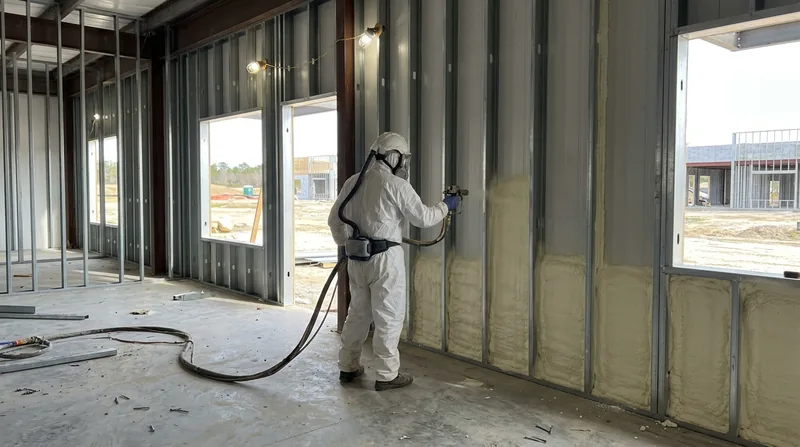




Commercial & New Construction Spray Foam in Jacksonville addresses the core thermal and moisture control challenge facing every commercial building across Onslow County. Summers here are hot and humid, with coastal-plain conditions that drive moisture inward through walls, ceilings, and roof assemblies. Whether you are constructing a new shop, retail space, or larger commercial structure, or retrofitting an existing building to control energy loss and condensation, spray foam insulation and air sealing are the most effective way to seal thermal leaks and manage the moisture that costs money every month. Jacksonville's mix of older industrial stock, newer military-adjacent commercial zones, and active construction means builders and property managers need an insulation partner who understands both new-build code compliance and retrofit logistics. We have served Onslow County since 2012, providing free commercial estimates with written R-value and thickness specifications so you know exactly what you are getting before work starts.
Why Commercial & New Construction Spray Foam Matters in Jacksonville's Building Environment
Jacksonville's commercial buildings face a specific challenge: hot, humid summers combined with vented crawl spaces and open-frame construction that let moisture and heat move freely through walls and ceilings. A retail building with a standard fiberglass attic loses conditioning to the roof deck all summer long, while a metal-frame shop or warehouse sees condensation form on the steel structure when warm, humid air meets the cold metal surface. Spray foam seals air leaks at the source, eliminates thermal bridging through wood and metal framing, and creates a continuous moisture barrier that keeps interior conditioning from bleeding away. For new construction, foam-sealed roof decks and wall cavities mean tighter, more efficient buildings from day one. For retrofits of existing commercial space, spray foam stops the costly cycle of energy loss without tearing apart finished ceilings or walls.
- Sealed roof decks and attics eliminate heat gain that drives cooling loads through the hottest months.
- Continuous air sealing around rim joists, band boards, and rim cavities stops infiltration at the building envelope.
- Closed-cell foam provides vapor control on metal building structures where condensation is the primary failure mode.
- New construction spray foam application meets thermal and code requirements in a single pass, speeding framing-to-roof timeline.
- Retrofit foam allows selective, non-invasive insulation of existing commercial spaces without demolition or extended downtime.
Each of these approaches saves money by reducing conditioning loss and extending equipment life in Jacksonville's humid climate.
Key info: Jacksonville's commercial building stock grew up around the military and spans from the 1970s onward. Older retail and industrial buildings typically have vented attics and minimal insulation, making them prime candidates for retrofit foam sealing. Newer construction can be specified with closed-cell or open-cell foam from the framing stage, ensuring code compliance and long-term efficiency from the start.
For guidance on what applies at your specific address, check with the Jacksonville building department or your city's code enforcement office. Permits and contractor registration vary by jurisdiction across Greater Jacksonville, and there is no reciprocity between cities, so always verify local requirements before work begins.
How We Approach Commercial & New Construction Spray Foam in Jacksonville
Our process starts with a free walkthrough estimate where we measure the space, identify thermal leaks and moisture entry points, and recommend the right foam type and coverage for your building's use and climate zone. We provide a written estimate with R-value and thickness specifications so you understand the scope before we schedule work. For new construction, we coordinate with your general contractor or builder to fit foam application into the framing-to-roof-closure window. For retrofit jobs, we work around your occupancy and operational constraints, using mechanical ventilation during cure and respecting your re-entry timeline.
- We conduct a free walkthrough estimate and document all thermal and air-sealing opportunities with written R-value and thickness specs.
- We recommend closed-cell foam for metal buildings and structures where moisture control is critical, or open-cell foam for cost-effective attic and wall sealing in new construction.
- We control application thickness per pass, maintain proper manufacturer drum temperature and mix ratio, and run mechanical ventilation throughout the cure period.
- We establish a clear re-entry window of 24 to 48 hours and provide written guidance on safe post-cure occupancy.
- We schedule work to fit new construction timelines or retrofit around your operational hours with minimal disruption.
This systematic approach ensures code-compliant installation and reliable long-term performance in Jacksonville's hot, humid environment.
Local example: A new warehouse in Richlands with a metal roof deck and steel frame needs closed-cell foam to prevent condensation and maintain R-value in a sealed assembly. A retrofit of an older retail space in Swansboro with a vented attic and open roof framing can use open-cell foam in the attic cavity, sealed at the rim and band joists, to stop thermal loss without the cost of a full encapsulation. Both start with a free estimate and a written spec.
For more detail on how closed-cell and open-cell foam differ in application and performance, see our closed-cell spray foam page and open-cell spray foam page.
Spray Foam Approaches for Commercial & New Construction
| Approach | Description | Best For |
|---|---|---|
| Closed-Cell Spray Foam | High-density foam (3.5 to 4.5 lbs/cf) with vapor barrier properties, R-value 6.0 to 7.0 per inch, moisture resistant. | Metal buildings, sealed roof decks, crawl spaces, rim joists, and any assembly where moisture control and structural support are required. |
| Open-Cell Spray Foam | Lower-density foam (0.4 to 0.7 lbs/cf) with sound-dampening properties, R-value 3.5 to 3.8 per inch, vapor-open once cured. | New construction attics, wall cavities, and interior spaces where cost efficiency and sound control are priorities. |
| Rim Joist & Band Joist Sealing | Closed-cell foam applied to rim cavities and band boards to seal thermal bridges and stop air infiltration at the building edge. | New construction and retrofit of existing commercial buildings, especially those with vented crawl spaces or slab-on-grade transitions. |
| Wall & Injection Foam Retrofit | Closed-cell or open-cell foam injected into existing wall cavities without demolition, sealed at penetrations and transitions. | Retrofit of pre-1980 commercial buildings with empty or failed insulation, allowing sealed-wall efficiency without facade work. |
Each approach is measured on site at the board foot and specified in the estimate with R-value and thickness so cost and performance are clear before installation begins.
Commercial & New Construction Spray Foam Cost in Jacksonville: What to Expect
The cost of spray foam insulation for commercial buildings depends on the size of the space, the type of foam (closed-cell or open-cell), the assembly being sealed (roof deck, walls, rim joists, or a combination), and access and site conditions. A small retrofit of rim joists and band boards on a commercial building in Jacksonville might start at one price point, while a full sealed roof deck on a new metal warehouse will be higher. The best way to understand cost for your project is to request a free commercial estimate. We measure on site, assess thermal and moisture control needs, and provide a written specification with R-value, thickness, and a realistic price range based on what you actually need.
Factors that affect cost include building footprint and height, whether the substrate is clean and dry (we do not spray over wet, contaminated, or leaking surfaces), roof or wall assembly type, and the number of penetrations and transitions that need to be sealed. A new construction project where foam is applied to open framing during the build process is typically more efficient than a retrofit where we work around existing structures and occupancy. For detailed pricing examples and to see how estimates are structured, visit our pricing page. Call us at (910) 554-3447 to schedule your free walkthrough and written estimate.
Getting 2 to 3 estimates from different contractors is always smart. Compare the R-value and thickness specs in each estimate, verify that mechanical ventilation and proper cure time are included, and ask about the contractor's insurance and reference projects. A low price with no written specification, no mention of ventilation during cure, or a promise of immediate re-entry should raise a red flag. The cheapest estimate is not always the best value.
What to Look for When Hiring a Spray Foam Insulation Contractor Near Jacksonville
Hiring the right spray foam contractor for your commercial project means verifying insurance, understanding the scope and specifications of the work, and checking references from recent commercial or new construction jobs. Jacksonville's contractor market includes local independent shops, national franchises, and out-of-state crews that move from job to job. The local independent with a local address and local plates is in the best position to stand behind the work and be reachable if questions arise after the cure is complete. Always ask for proof of current insurance, get multiple written estimates with R-value and thickness specifications, and ask for references you can contact about similar jobs.
- Verify that the contractor is fully insured with current coverage for spray foam application and carries a certificate of insurance you can review.
- Request a written estimate with R-value per inch, application thickness, square footage or board-foot coverage, and a clear price before work begins.
- Ask for references from commercial or new construction projects completed in the last 12 months, and contact at least two to ask about quality, timeline, and post-cure support.
- Confirm that the contractor will use mechanical ventilation during cure, establish a 24 to 48 hour re-entry window, and provide written post-cure guidance.
- Understand local permitting requirements for your project by contacting your city or county building department, and confirm that the contractor will coordinate with inspectors if required.
- If your building is in an HOA or master-planned community, review architectural guidelines for exterior work or metal building modifications before hiring, and confirm the contractor understands any restrictions.
These steps protect your investment and ensure the work meets code and performs as specified.
Ready to move forward? Contact us for a free commercial estimate or call (910) 554-3447 to discuss your project.
Commercial & New Construction Spray Foam in Jacksonville: Pricing Guide
| Service | Price | Details |
|---|---|---|
| Free commercial walkthrough estimate | Free | Includes site measurement, thermal assessment, written R-value and thickness specs, no obligation to book |
| Closed-cell spray foam, roof deck or sealed assembly | Starting at $2.50/board-foot | Varies by building footprint, assembly type, access, and moisture control requirements identified in estimate |
| Open-cell spray foam, new construction attic or walls | Starting at $0.85/board-foot | Cost-effective option for new builds and retrofits where vapor permeability and sound control are acceptable |
| Rim joist and band joist sealing retrofit | Starting at $1.50/board-foot | Sealed-cavity application to stop thermal bridging and infiltration, measured on site at the board foot |
| Wall and injection foam retrofit | On estimate | Existing cavity assessment, substrate condition, and access determine final price, provided in written specification |
| Travel and scheduling | Included | No mileage fee or travel surcharge within Jacksonville and surrounding service areas |
Indicative pricing, the exact cost depends on square footage, finish, and site access. Free personalized estimate within 24h at (910) 554-3447.


