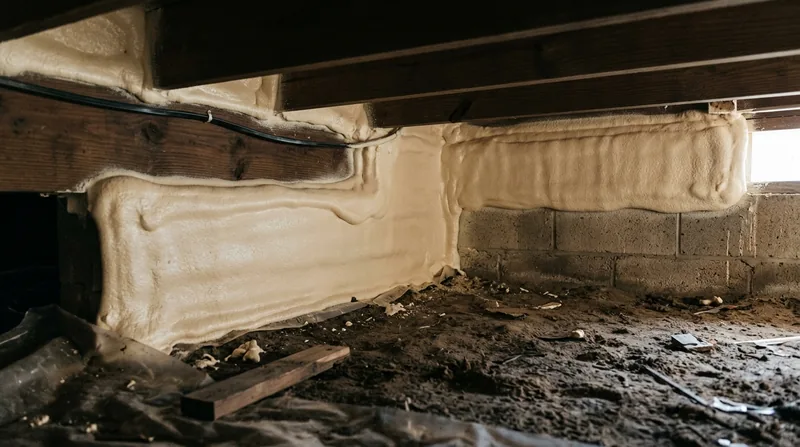




Closed cell spray foam insulation in Jacksonville delivers the moisture barrier and structural rigidity that Onslow County's humid coastal climate demands. Most homes here were built from the 1970s onward across Jacksonville, Sneads Ferry, Richlands, and Swansboro with vented crawl spaces sitting on sandy coastal-plain ground, and summer heat combined with moisture pushing through walls and attics drives cooling costs from spring straight through fall. Closed cell foam adds a vapor retarder in one application, stops air leakage at rim joists and band joists where moisture enters, and hardens on impact for structural support on garage ceilings and metal building walls. We've been installing closed cell and open cell spray foam across Greater Jacksonville since 2012, and we size every job to the building assembly it protects. If your attic, crawl space, garage, or metal building is losing conditioned air or sweating under humid coastal conditions, closed cell foam is often the answer. Call us at (910) 554-3447 for a free written estimate, or read more about attic spray foam insulation to understand how we approach sealed roof decks and vented attic tops.
Why Closed Cell Spray Foam Matters in Jacksonville's Humid Climate
Jacksonville sits in climate zone 3A with hot, humid summers where moisture doesn't dry out, it accumulates. Vented crawl spaces under older homes pull in damp coastal air that keeps rim joists, band joists, and floor systems sweating for months. Attics bake under asphalt shingles while moisture pushes upward through top plates, rim penetrations, and electrical chases. Closed cell foam solves this in two ways: it creates a vapor retarder that stops moisture vapor from moving through the assembly, and it seals every air leak that would otherwise let humid air infiltrate into cavities where it condenses on cooler surfaces.
- Closed cell foam compresses to a rigid foam that adds structural bracing to rim joists and crawl space walls under load and settlement.
- The closed cell structure traps air in tiny bubbles, creating an R-value of 6 to 7 per inch compared to open cell's 3.5 to 4 per inch, so you need less thickness to hit your R-target.
- Applied over band joists and rim joists, it seals the rim cavity completely, stopping the warm-to-cool air exchange that drives moisture into the band joist lumber itself.
- In metal buildings and pole barns across Onslow County, closed cell prevents condensation on the steel roof deck by keeping the steel warm relative to the outside dew point.
- On garage ceilings and shop walls, closed cell hardens in minutes and can handle foot traffic or equipment placement without sagging or settling.
The moisture failure mode in Jacksonville is not standing water or mold growth alone, it is the slow wicking of humidity into wood framing and the condensation that forms on cool surfaces when warm, humid air meets an uninsulated or poorly sealed rim joist or crawl space wall. Closed cell stops that cycle.
Key info: Jacksonville building officials enforce the energy code and thermal barrier rules at your address. Closed cell foam applied to rim joists and crawl space walls must meet the ignition barrier requirement, which we handle during installation. Always verify what applies to your specific property by checking with your local building department before booking.
How We Install Closed Cell Spray Foam in Jacksonville
Our process starts with an on-site walkthrough where we measure the cavity, check for moisture or contamination, and confirm that the substrate is dry and ready to receive foam. We do not spray over wet crawl spaces, leaking rim joists, or roofs with active water entry. If we find moisture first, we tell you what needs fixing and refer you to the right trade. Once the surface is clean and dry, we set up mechanical ventilation in the work area, mix the closed cell foam at the correct drum temperature and ratio, and apply it in controlled passes to hit the exact thickness and R-value your estimate specifies.
- We measure the cavity depth and width on site to calculate the board feet needed and confirm the R-value before we spray a single pass.
- Mechanical ventilation runs during the cure period to remove isocyanate vapors and ensure safe air quality in the home.
- We observe a twenty-four to forty-eight hour re-entry window after cure, which we state in writing on your estimate and invoice.
- Once cured, closed cell foam is trimmed flush with the rim joist or cavity opening, and any exposed foam is covered with a thermal barrier if required by code at your address.
- We inspect the installation for complete coverage, proper thickness, and no voids before we leave the site.
On a typical rim joist and band joist job in Jacksonville, we finish in one to two days depending on the linear feet and whether we are also sealing other penetrations. On a crawl space wall, we may take longer if the space is tight or if we are removing old fiberglass first. Our insulation removal service handles the tearout before we spray new foam.
Local example: A Sneads Ferry home built in 1985 with an open vented crawl space had sweating rim joists and a damp floor in summer. We sealed the rim joist and the crawl space band with 2 inches of closed cell foam, which gave it an R-value of 13 and a complete vapor barrier. The homeowner reported no more moisture on the rim lumber and noticeably less dust and humidity in the crawl space by the following summer.
Closed Cell Spray Foam Installation Methods and Applications
| Application | Description | Best for Jacksonville Homes |
|---|---|---|
| Rim and Band Joist Sealing | 2 to 3 inches of closed cell foam applied to the rim cavity and rim band from the concrete or slab edge to the first floor rim. | 1970s-1990s homes with vented crawl spaces where moisture and air infiltration drive cooling costs and floor dampness. |
| Crawl Space Wall Insulation | Closed cell foam sprayed on the interior face of crawl space walls to create a vapor barrier and reduce humidity and air infiltration. | Sandy coastal-plain crawl spaces that pull in damp air and cause sweating ducts, condensation on pipes, and musty odors. |
| Garage Ceiling and Wall Foam | Closed cell foam applied to garage ceilings and walls for thermal control and structural support, with rigid finish ready for shelving or equipment. | Attached garages in subdivisions across Jacksonville and Richlands where summer heat gain and moisture infiltration raise whole-home cooling loads. |
| Metal Building and Pole Barn Condensation Control | Closed cell foam sprayed on the interior of metal roof decks and walls to prevent condensation by keeping the steel warm relative to outdoor dew point. | Agricultural and commercial metal buildings across Onslow County where humid coastal air condenses on uninsulated steel in spring and fall. |
| Sealed Attic Roof Deck Insulation | Closed cell foam sprayed on the underside of roof sheathing to create a sealed attic that eliminates soffit and ridge vents and stops moisture intrusion. | Homes with asphalt shingle roofs where summer heat bake and moisture pushing through top plates drive attic temperatures above 140 degrees. |
Each application is sized to the climate zone, the moisture risk, and the building assembly. We do not apply a one-size-fits-all thickness; we specify R-value and thickness on every estimate so you know what you are paying for and what protection you are getting.
Closed Cell Spray Foam Insulation Cost in Jacksonville: What to Expect
Closed cell spray foam in Jacksonville starts at approximately $1.20 per board foot for straightforward rim joist or crawl space wall jobs where access is easy and the substrate is ready to spray. A typical rim joist and band joist sealing on a 1,500-square-foot ranch home with 150 linear feet of rim cavity runs 75 to 100 board feet of closed cell foam, which puts the material and labor cost in the $900 to $1,200 range before any removal of existing insulation. Crawl space walls are priced per linear foot of wall height and perimeter, and prices move up if we have to remove old fiberglass, treat standing moisture, or work in confined spaces where crew access is slow.
Several factors affect the final cost. Access to the rim joist, crawl space, or attic determines how long the crew spends setting up and moving equipment. If the substrate has old fiberglass or other insulation, we remove it first at an additional cost. Moisture on the surface delays the job because we do not spray over wet substrate. Thickness and R-value targets are set by you and your building code, and thicker foam costs more per board foot because it takes more material and more passes. Metal buildings and pole barns with large roof decks run higher per board foot because of the spray equipment setup and the crew size needed to cover the area in a single day.
We always provide a written estimate with R-value and thickness specifications before we schedule the job. That estimate breaks out material, labor, and any removal or prep work so you see exactly what you are paying for. We recommend getting two or three estimates from local spray foam contractors so you can compare scope, R-value, and price. Our estimate is free and comes with no obligation to book. Call us at (910) 554-3447 or visit our pricing page for more detail on what moves the cost up and down for your specific job.
Closed Cell Spray Foam Insulation Near Me: What Jacksonville Homeowners Should Know When Hiring
The spray foam insulation trade has two types of installers: the local independent shop with a local address and long-term reputation, and the out-of-state rig-and-run crew or national franchise that sprays a job in an afternoon and is gone before the smell fades. When you hire, verify that your contractor is fully insured and can provide a certificate of insurance on request. Ask for references from jobs done in the last two years in Jacksonville or nearby towns, and call those references to ask about the cure time, the smell, whether the crew explained the re-entry window, and whether they had any issues after the work was done. Do not hire based on price alone. A bid far below market is a red flag for incomplete scope, no R-value specification, or a crew that cuts corners on mechanical ventilation and cure time.
In Jacksonville, closed cell foam work does not typically require a permit unless it is part of a larger attic or crawl space encapsulation project. Check with your local building department to confirm what applies to your address. If your home is in an HOA or a master-planned community, verify that exterior work on metal buildings or garages does not require architectural approval. North Carolina utility locates through 811 are required by law before any excavation, but spray foam insulation work rarely involves digging, so this is not usually a factor.
Ask your contractor whether they use closed cell or open cell foam and why they recommend one over the other for your specific job. Closed cell is the right choice for moisture control and structural support; open cell is the right choice for sound dampening and cost savings on attics that are already dry. A contractor who recommends closed cell for every job without asking about your moisture situation or your R-value target is selling product, not solving problems. We walk through every assembly with you, specify the foam type and thickness in writing, and explain why it is the right choice for your home and your climate zone.
Contact us at Jacksonville Spray Foam Insulation for a free estimate. We respond within 24 hours and can usually schedule your job within two to three weeks depending on the season. We have been serving Jacksonville, Sneads Ferry, Richlands, Swansboro, and the Crystal Coast since 2012, and we stand behind every installation with a one-year workmanship warranty.
Closed Cell Spray Foam Insulation in Jacksonville: Pricing Guide
| Service | Price | Details |
|---|---|---|
| Rim Joist and Band Joist Sealing | Starting at $1.20/board ft | Closed cell foam 2 to 3 inches thick on rim cavity, typical job 75 to 100 board feet, includes removal of old insulation if present |
| Crawl Space Wall Insulation | Starting at $1.20/board ft | Closed cell foam on interior crawl space walls, priced per linear foot of wall height and perimeter, includes moisture assessment before spraying |
| Garage Ceiling and Wall Insulation | Starting at $1.20/board ft | Closed cell foam on garage ceilings and walls for thermal and structural support, access and substrate condition determine final price per board foot |
| Metal Building and Pole Barn Roof Deck | Starting at $1.20/board ft | Closed cell foam on interior steel roof decks and walls to prevent condensation, large spray area and crew setup typically result in higher per-board-foot cost |
| Sealed Attic Roof Deck Insulation | Starting at $1.20/board ft | Closed cell foam on underside of roof sheathing for sealed attic, includes removal of existing fiberglass and ventilation during cure |
| Free Written Estimate | No charge | R-value and thickness specifications included, response within 24 hours at (910) 554-3447, no obligation to book |
Indicative pricing, the exact cost depends on square footage, finish, and site access. Free personalized estimate within 24h at (910) 554-3447.


