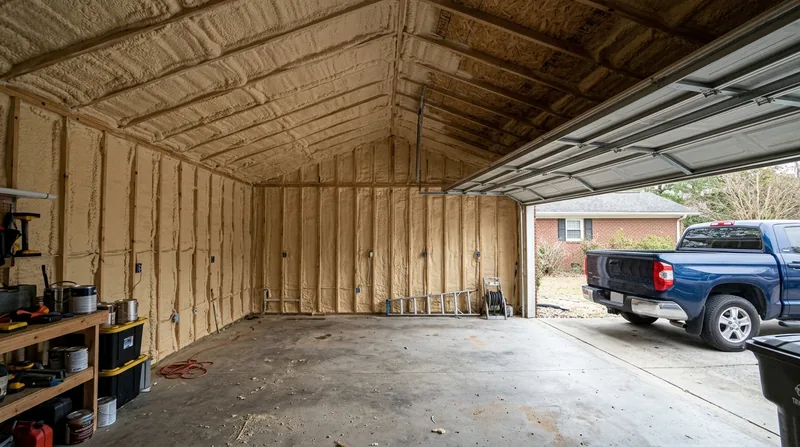




Garages across Onslow County face the same hot, humid conditions as the houses beside them, and that summer heat gain translates directly into higher cooling bills and uncomfortable storage spaces. Whether you park vehicles in Jacksonville, Sneads Ferry, or Richlands, or use your garage as a workshop or storage zone, garage spray foam insulation cuts through-wall heat transfer and keeps the interior more stable through the humid stretch from May through September. We spray foam the walls and ceiling to seal air leaks, reduce solar heat gain under asphalt shingles and metal roofing, and create a thermal boundary that protects stored items, vehicles, and the conditioned space next door. Unlike fiberglass batts or blown-in cellulose, spray foam adheres to framing and fills every cavity and penetration in a single pass, eliminating the convection loops that let hot coastal air circulate through loose insulation. Most garages in this region were built with minimal or no insulation, leaving them as thermal sieves that pull cooling from adjacent living spaces and waste energy all summer long. A properly sprayed garage becomes a buffer zone, not a liability. We handle everything from small single-car garages in Holly Ridge to large two-car and three-car bays in Hampstead and Swansboro, plus attached garages where the shared wall touches your bedroom or kitchen.
Why Garage Spray Foam Insulation Matters in Jacksonville's Heat and Humidity
Jacksonville and the surrounding Onslow County area sit in climate zone 3A, where summer heat and humidity are relentless from late spring through early fall. Garages with no insulation or only a thin layer of fiberglass allow outdoor air to infiltrate through rim joists, band board gaps, and poorly sealed doors and penetrations. That uncontrolled air movement drives cooling costs higher and makes the garage itself uncomfortable for any extended use. Spray foam eliminates those air leaks while providing a true R-value barrier, which is especially critical in a garage where the roof and exterior walls face direct solar exposure and the ground-level perimeter sits exposed to damp coastal-plain air.
- Spray foam seals all air leaks in a single application, stopping convection that fiberglass cannot control.
- Closed cell foam provides higher R-value per inch, critical when garage ceiling height or wall space is limited.
- Open cell foam costs less and works well for garages where sound dampening matters more than maximum R-value.
- Proper insulation protects vehicles from extreme temperature swings and reduces moisture condensation on tools and stored items.
- A sealed garage reduces the cooling load on adjacent living spaces by eliminating thermal bypass through shared walls.
Choosing the right foam type and thickness for your garage depends on your climate zone, the existing insulation, and whether the garage is conditioned or unconditioned. We assess each garage on site and recommend the approach that delivers the best return on your investment.
Key info: Jacksonville's summer cooling season runs May through September, with peak demand in July and August. A single-car garage with no insulation can lose 40 to 60 percent of conditioned air to the surrounding structure, pushing cooling bills higher and making the adjacent bedroom or kitchen noticeably warmer. Spray foam stops that loss entirely.
For more on how spray foam works across all applications, see our guide to closed cell spray foam insulation and open cell spray foam insulation to understand the trade-offs between performance and cost.
How We Spray Foam and Seal Your Garage in Jacksonville
Our process starts with a site visit to measure the garage dimensions, identify air leaks and thermal bypasses, and determine whether existing insulation needs removal or can be sprayed over. We then recommend the foam type (closed cell for maximum R-value and moisture resistance, or open cell for lower cost and sound dampening), specify the thickness in inches to meet your target R-value, and provide a written estimate that shows the board footage, R-value per inch, and total cost. On the spray day, we set up mechanical ventilation, protect the floor and any fixtures, and apply the foam in controlled passes to achieve the specified thickness and density. Once cured (typically 24 to 48 hours), the foam is fully set and you can resume normal use of the garage.
- We schedule a free on-site estimate at your convenience, measure the garage, and identify all air leaks and penetrations.
- We provide a written estimate showing R-value, thickness in inches, board footage, and the total cost with no surprises.
- We set up mechanical ventilation during the spray to manage off-gassing and ensure a safe cure environment.
- We apply foam to walls, ceiling, and any rim board or band joist areas where air leaks occur, sealing every gap in one pass.
- We allow the full cure window (24 to 48 hours) before you occupy the space, and we explain the re-entry protocol.
If your garage has old or damaged insulation, we can remove it first and dispose of it responsibly before spraying new foam. See our insulation removal service for details on that process.
Example: A two-car garage in Swansboro with no insulation, vented soffit, and a rim board open to the crawl space below gets 4 inches of closed cell foam on the ceiling and walls, plus 2 inches in the rim joist cavity. Total cost typically ranges from $2,400 to $3,200 depending on final board footage. The garage stays 10 to 15 degrees cooler in summer and the adjacent bedroom no longer feels like a heat sink.
Garage Spray Foam Methods: Closed Cell vs. Open Cell
| Foam Type | R-Value per Inch | Best for Garages |
|---|---|---|
| Closed Cell Spray Foam | 6.0 to 7.0 | Maximum thermal resistance and moisture control; ideal for garages with limited wall or ceiling space, attached garages where shared walls touch conditioned living space, and garages in humid coastal areas where condensation risk is high. |
| Open Cell Spray Foam | 3.6 to 4.0 | Lower cost and good sound dampening; effective for detached garages where R-value is less critical, workshop spaces where noise control matters, and budgets that prioritize air sealing over maximum insulation depth. |
| Hybrid or Partial Spray | Varies (2 to 5) | Open cell base layer with closed cell top-up in moisture-prone areas like rim joists; cost-effective for large garages or when existing insulation can be preserved and supplemented. |
| Spray Over Existing Insulation | Additive to existing | Upgrading older fiberglass or cellulose without full removal; spray foam seals air leaks and adds R-value while the old insulation stays in place, reducing labor and disposal cost. |
The choice between closed and open cell depends on your garage use, budget, and the existing condition of walls and ceiling. We recommend closed cell for attached garages and high-humidity environments, and open cell for detached garages or when cost is the primary driver. A site visit lets us show you the difference and help you decide.
Garage Spray Foam Insulation Cost in Jacksonville: What to Expect
Garage spray foam insulation in Jacksonville typically starts at $1,200 for a small single-car garage with 4 inches of open cell foam on walls and ceiling. A two-car garage runs $2,400 to $3,200 depending on ceiling height, whether rim joist areas need foam, and whether existing insulation must be removed first. Closed cell foam costs more per board foot than open cell but delivers higher R-value per inch, so a two-car garage in closed cell might run $3,200 to $4,500. The final price depends on several concrete factors: the total square footage of walls and ceiling, the foam type and target thickness, whether you need insulation removal beforehand, and the accessibility of the space (tight attic access or low headroom adds time and cost).
Getting multiple estimates is the best way to understand the market and ensure you are comparing apples to apples. Ask each contractor for a written estimate that shows R-value per inch, total thickness, board footage, and the foam type. Avoid estimates with no R-value specified, no thickness detail, or prices far below market, as these are often signals of poor installation or hidden costs. We provide free written estimates within 24 hours at (910) 554-3447, with no obligation to book. See our pricing page for a full breakdown of what drives cost across all our services.
One common misconception is that garage insulation is a luxury. In reality, it is one of the fastest-payback insulation upgrades because garages waste so much conditioned air and heat. If your garage is attached to your home or you spend time working in it, the comfort and energy savings justify the investment within a few cooling seasons.
Garage Spray Foam Insulation Near Me: What Jacksonville Homeowners Should Know Before Hiring
Hiring the right spray foam contractor is critical because poor installation (wrong ratio, insufficient thickness, no ventilation during cure, immediate re-entry promised) can lead to off-gassing, incomplete curing, and performance failures that cost thousands to fix. Before you book anyone, verify that the contractor is fully insured and can provide proof of coverage. Ask for written estimates from at least two contractors and compare R-value, thickness, and total cost side by side. Check references from recent garage or attic jobs and ask those homeowners whether the installer was responsive, professional, and whether they were satisfied with the result. If your garage is part of an HOA, confirm that exterior work (roof, vents, or trim) complies with architectural guidelines. For interior work, most cities do not require a permit for garage insulation, but if your garage has a finished interior or is part of a historic district, confirm with your local building department.
- Verify that any contractor you hire is fully insured and can provide a certificate of insurance before work begins.
- Get written estimates from at least two contractors, each showing R-value per inch, total thickness, board footage, and foam type.
- Ask for references from recent garage jobs and contact them to confirm quality and responsiveness.
- Confirm that the contractor will use mechanical ventilation during the spray and will specify a re-entry window of 24 to 48 hours.
- Check your city or county building department website to confirm whether a permit is required for garage insulation at your address.
- If your property is in an HOA, verify that exterior modifications (vents, roof penetrations) comply with architectural rules before work begins.
We are fully insured and have served Jacksonville, Sneads Ferry, Richlands, Swansboro, and the surrounding Onslow County area since 2012. We provide free written estimates and can answer any questions about permits or local requirements. Call us at (910) 554-3447 or visit our contact page to request a free estimate with no obligation.
Garage Spray Foam Insulation in Jacksonville: Pricing Guide
| Service | Price | Details |
|---|---|---|
| Single-car garage, open cell foam | Starting at $1,200 | 4 inches of open cell on walls and ceiling, includes air sealing at rim board and door frame penetrations |
| Two-car garage, open cell foam | Starting at $2,400 | 4 inches of open cell on walls and ceiling, includes rim joist and soffit sealing, final cost varies with ceiling height and existing insulation removal |
| Two-car garage, closed cell foam | Starting at $3,200 | 4 inches of closed cell on walls and ceiling for maximum R-value and moisture control, includes rim joist and all air leak sealing |
| Insulation removal and replacement | On estimate | Old or damaged fiberglass and cellulose removal, disposal, and new foam spray requires on-site measurement to determine volume and labor |
| Travel and estimates | Free estimate, included travel | No travel charge in Jacksonville and surrounding Onslow County areas, free written estimate within 24 hours at (910) 554-3447 |
Indicative pricing, the exact cost depends on square footage, finish, and site access. Free personalized estimate within 24h at (910) 554-3447.


