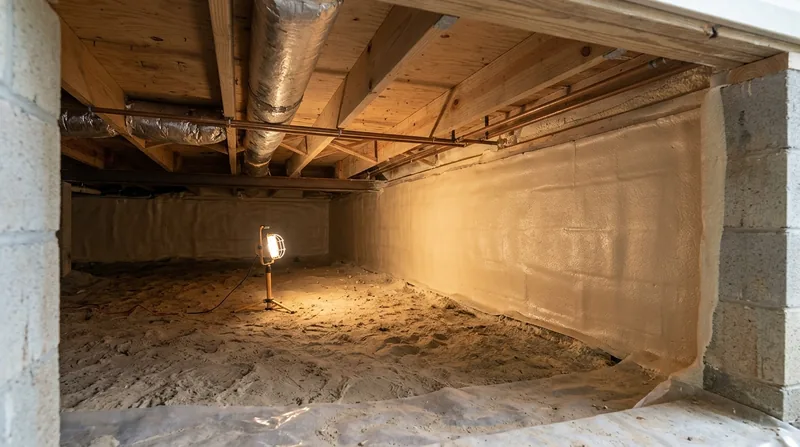




Crawl Space Spray Foam Insulation in Jacksonville stops moisture and humidity from creeping into the floors and ductwork of homes built on sandy coastal-plain ground. Jacksonville's housing stock, much of it built from the 1970s onward to house military families, sits on vented crawl spaces that pull in damp air most of the year. In climate zone 3A, that moisture drives sweating floors, mold risk on rim joists, and cooling bills that climb through spring and summer. We spray foam across crawl space walls and band joists to seal out that coastal humidity, keep floors dry, and protect ductwork from condensation. The result is a stable floor temperature, lower cooling costs, and a crawl space that stays dry year-round. Learn how spray foam insulation works across all applications.
Why Crawl Space Spray Foam Insulation Matters in Jacksonville's Climate
Vented crawl spaces are the norm under Jacksonville homes, and they are a liability in a humid subtropical climate. Every time the temperature drops at night or a rain system moves in, humid air flows into the crawl space and condenses on cold surfaces. Fiberglass batts absorb that moisture, lose their R-value, and collapse. Ductwork sweats. Rim joists and band joists rot from the inside. The cost of cooling a damp crawl space compounds month after month, especially during the May-through-September stretch when outdoor humidity stays above 70 percent and indoor air conditioning creates a temperature gradient that pulls moisture inward through every crack and seam.
- We seal crawl space walls with closed cell spray foam to block moisture infiltration and maintain a dry thermal boundary.
- Foam insulation stops condensation on ductwork and prevents mold growth on band joists and rim joists.
- A sealed crawl space reduces the cooling load on your air conditioner by removing the need to condition outdoor air that enters through vents.
- The air seal also stops cold drafts in winter and stabilizes floor temperature year-round.
Jacksonville's building department enforces energy and building code requirements for crawl space insulation, including ventilation rules and thermal barrier specifications. We help you navigate what applies at your address and work within those rules.
Key info: Vented crawl spaces in Jacksonville pull in damp coastal air that keeps floors and ductwork sweating for months. Closed cell spray foam seals out that moisture and stops the cooling load that humidity creates. A homeowner in Richlands or Sneads Ferry typically saves 15 to 25 percent on cooling costs after a crawl space seal, depending on the size of the space and the starting condition.
For more detail on the difference between closed cell and open cell foam, see our closed cell spray foam insulation page.
How We Seal and Insulate Crawl Spaces in Jacksonville
Our process starts with a site visit to assess the crawl space condition, measure the walls and band joists, and identify any moisture sources or substrate issues. We do not spray over wet crawl spaces or leaking foundations. If the space needs drying or grading correction first, we walk away and tell you so. Once the substrate is dry and ready, we spray closed cell foam at the correct thickness and density, control the ratio and drum temperature, and maintain mechanical ventilation during cure. Re-entry is safe after 24 to 48 hours, and we provide a written estimate with R-value and thickness specifications before we schedule the work.
- We inspect the crawl space for moisture, standing water, or damage that must be addressed before foam is applied.
- We seal all band joists, rim joists, and the perimeter walls with closed cell spray foam at the specified R-value and thickness.
- We install mechanical ventilation during the cure process and confirm re-entry safety before you occupy the space.
- We provide a written estimate with R-value, thickness, square footage, and board-foot total before scheduling.
- We test the air seal with blower door confirmation to verify that the crawl space is no longer pulling in outdoor air.
The whole job typically takes one to two days, depending on the size of the crawl space and the complexity of access.
Example: A 1,200-square-foot crawl space under a two-story home in Swansboro with 2-foot clearance and easy access might take one full day. A tighter or larger space in Hampstead with obstructions or low headroom takes longer and may require two visits. We measure and quote on site.
See our air sealing page for more on how we verify the integrity of the seal.
| Approach | Description | Best for |
|---|---|---|
| Closed Cell Foam Walls and Band Joists | High-density closed cell foam sprayed on crawl space walls and rim joists to R-20 or R-24, creating a moisture barrier and air seal in one pass. | Crawl spaces in humid climates where moisture control is the primary goal and structural support is needed. |
| Rim Joist and Band Joist Sealing | Closed cell foam applied to the band joist perimeter where the rim meets the foundation, stopping air infiltration and condensation on wood framing. | Any crawl space retrofit or new construction where the rim joist is exposed and accessible. |
| Full Crawl Space Encapsulation with Foam | Foam applied to walls, joists, and foundation perimeter, with a complementary ground cover or vapor barrier (handled by a separate encapsulation contractor). | Large or severely damp crawl spaces where complete moisture isolation is the goal. |
| Partial Retrofit on Existing Fiberglass | We remove wet or failed fiberglass batts, dry the space, and apply closed cell foam to walls and joists to restore the thermal boundary. | Older homes in Jacksonville where original fiberglass has absorbed moisture and lost effectiveness. |
Crawl Space Spray Foam Insulation Cost in Jacksonville: What to Expect
A crawl space spray foam insulation job in Jacksonville typically starts at $2,500 to $4,500 for a standard 1,000 to 1,500 square foot space with easy access and dry substrate. The final price depends on the size of the crawl space, the thickness and R-value you choose, the accessibility of walls and joists, and whether we need to remove existing insulation first. A tight or obstructed crawl space costs more because it takes longer to set up equipment and spray the walls evenly. If the space has standing water or wet fiberglass, we factor in removal and drying time, which increases the total.
The best way to know what your job costs is to request a free, no-obligation estimate. We measure on site, specify the R-value and thickness in writing, and give you a firm price before we start. Get estimates from two or three contractors so you can compare not just price but also the detail in the estimate itself. A vague quote with no R-value, no thickness, and no board-foot total is a red flag that the contractor does not know the job or is hiding the scope.
See our full pricing overview for more examples and the factors that move the cost up or down.
Crawl Space Spray Foam Insulation Near Me: What Jacksonville Homeowners Should Know When Hiring
Hiring the right spray foam contractor is the difference between a durable, properly cured installation and a job that smells for weeks and fails early. Before you sign a contract, verify that the contractor is fully insured and can provide proof of coverage. Ask for references from recent jobs in Jacksonville or nearby towns and actually call them. Check that the contractor provides a written estimate with R-value, thickness, square footage, and board-foot total. Do not accept a vague price per square foot or a handshake deal. Understand what permits apply at your address by checking with the Jacksonville building department, and confirm that your contractor will help you navigate the process.
- Request a written estimate with R-value, thickness, and board-foot total before any work is scheduled.
- Verify that the contractor is fully insured and ask for a certificate of insurance naming your address.
- Call at least two references from recent crawl space jobs in Jacksonville or Onslow County.
- Confirm that the contractor will provide mechanical ventilation during cure and a stated re-entry window of 24 to 48 hours.
- Ask whether permits are required at your address and what the contractor's role is in the permitting process.
- Do not hire a contractor who promises immediate re-entry, offers a price far below market with no inspection, or cannot verify insurance.
The local independent contractor with a local address and local plates is positioned differently from national franchises and out-of-state rig-and-run crews. We have been in business since 2012 and we stand behind our work. Call us for a free estimate at (910) 554-3447.
Crawl Space Spray Foam Insulation in Jacksonville: Pricing Guide
| Service | Price | Details |
|---|---|---|
| Small crawl space (600-900 sq ft) | Starting at $2,500 | Closed cell foam on walls and band joists, easy access, dry substrate included |
| Standard crawl space (900-1,500 sq ft) | Starting at $3,500 | Full perimeter seal with foam, moderate access, removal of wet fiberglass if needed |
| Large or complex crawl space (1,500+ sq ft) | On estimate | Size, obstructions, access difficulty, and substrate condition require on-site measurement |
| Existing fiberglass removal and replacement | Starting at $1,200 | Labor to remove failed batts, haul-away, and drying time before foam application |
| Service area and travel | Included | No separate charge for Jacksonville, Sneads Ferry, Richlands, Swansboro, and surrounding areas |
| Free estimate | Free | Response within 24 hours at (910) 554-3447, no obligation to book, written quote provided |
Indicative pricing, the exact cost depends on square footage, finish, and site access. Free personalized estimate within 24h at (910) 554-3447.


