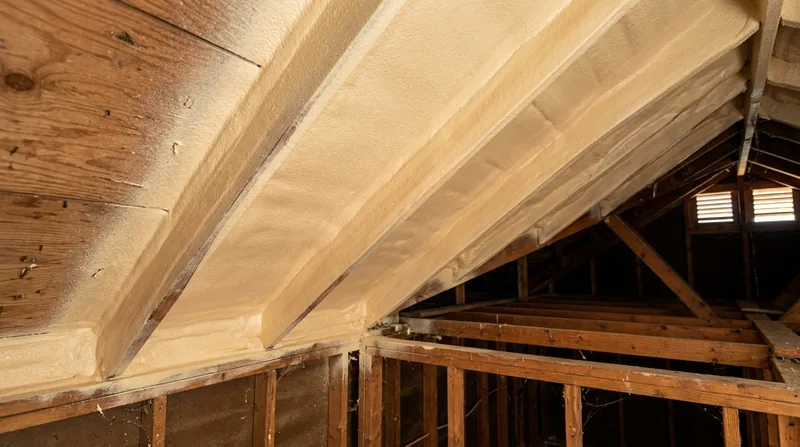




Jacksonville's attics bake under asphalt shingles through long, humid Onslow County summers. Military families rotating through the area have filled neighborhoods from the 1970s onward with single-story ranches and two-story subdivisions stretching toward Hubert, Richlands, and Sneads Ferry. Most of these homes were built with vented attics, and that ventilation strategy backfires in climate zone 3A: hot, humid air pushes moisture into the ceiling cavity from spring through hurricane season, while the attic itself reaches 140 to 160 degrees under the roof deck. We spray foam insulation against the roof deck to block that heat gain and seal the air leaks that let moisture drive into ceilings. The result is a conditioned attic that stays dry, cuts cooling loads, and holds steady humidity year-round.
Why Attic Spray Foam Insulation Matters in Jacksonville's Hot, Humid Climate
Jacksonville summers are long and relentless. Asphalt shingles absorb solar radiation and transfer that heat directly into the attic space. A vented attic draws in damp coastal air from the New River watershed and surrounding sandy terrain, and that moisture condenses on ducts, insulation, and framing whenever the indoor air conditioning runs. The result is sweating ducts, mold risk on wood framing, and cooling bills that climb from April through September. Spray foam against the roof deck stops both problems at once: it blocks the heat before it enters the living space, and it seals the air leaks that let moisture-laden air infiltrate from outside.
- Closed cell spray foam creates an air-tight seal that stops moisture infiltration at the roof deck and prevents condensation on ducts and framing.
- The foam itself is hydrophobic and does not absorb water, so it stays stable even in the high-humidity environment typical of Onslow County summers.
- A sealed attic eliminates the need for soffit and ridge vents, which pull in damp coastal air and defeat the purpose of air conditioning.
- Cooling costs drop because the attic no longer acts as a thermal load on the air-conditioning system.
These factors together make attic spray foam the signature retrofit in Jacksonville's military housing stock and the neighborhoods built around it.
Key info: Jacksonville's building code requires a thermal barrier between foam and living space in attics. A fifteen-minute thermal barrier (drywall, intumescent coating, or fiberglass blanket) is mandated by code and is the distinction most DIY installers miss. We install it as part of the job. Verify the requirement with the Jacksonville or Onslow County building department for your address, and ask any contractor to name the barrier type they plan to use.
For more detail on the closed cell product and its R-value performance in this climate, see our closed cell spray foam insulation page.
How We Spray Foam Your Jacksonville Attic: The Process
We start with a site inspection to measure the attic, identify air leaks, and assess the existing insulation and roof condition. We take photographs and prepare a written estimate that specifies the R-value, foam thickness in inches, the type of foam (closed cell or open cell), and the cost per board foot. Once you approve the estimate, we schedule the work and prepare the attic for spraying.
- We remove or leave in place existing fiberglass batts and blown-in insulation, depending on condition and your preference (removal adds cost but ensures full contact between foam and roof deck).
- We seal large air leaks around ductwork, plumbing penetrations, and recessed lights with foam or caulk before the spray application.
- We apply closed cell or open cell foam in multiple passes, controlling thickness to code and manufacturer specifications, and we maintain the correct drum temperature and spray ratio.
- We provide mechanical ventilation during the cure period (typically 24 to 48 hours) and give you a re-entry window before the attic is safe for foot traffic or storage.
- We install the required thermal barrier (drywall or intumescent coating) if code requires it for your address.
The entire process takes one to three days depending on attic size and whether existing insulation is removed.
Example: A 1,200-square-foot attic in Sneads Ferry with existing fiberglass batts and three roof penetrations typically takes two days: day one for removal and sealing, day two for foam application and cure setup. We provide a detailed timeline in the estimate.
For details on air sealing and how it complements spray foam, visit our air sealing page.
Attic Spray Foam Methods: Closed Cell vs. Open Cell
| Approach | Description | Best for Jacksonville Attics |
|---|---|---|
| Closed Cell Spray Foam | Dense, rigid foam with R-value around 6.5 to 7 per inch. Hydrophobic, does not absorb moisture. Requires 3 to 4 inches for typical attic performance. | Hot, humid Jacksonville climate where moisture control is critical. Sealed attics in military housing stock and new construction. |
| Open Cell Spray Foam | Light, fluffy foam with R-value around 3.6 to 3.8 per inch. Vapor-permeable, allows moisture to pass through. Requires 5 to 6 inches for equivalent R-value. | Retrofit projects where attic depth is limited or cost is the primary driver. Works best in drier climates or where ventilation is maintained. |
| Blown-In Fiberglass (Top-Up) | Loose-fill batts installed over existing insulation. R-value around 3.2 to 3.6 per inch. Does not seal air leaks or control moisture. | Simple R-value boost on sound existing insulation with no air leaks. Not recommended in Jacksonville's humid climate for new sealing projects. |
| Full Removal and Closed Cell Retrofit | Remove all existing insulation, seal air leaks, apply closed cell foam to roof deck, install thermal barrier. Complete solution for failed or moldy insulation. | Jacksonville homes with moisture damage, mold history, or insulation more than 20 years old. Provides long-term durability and moisture control. |
Closed cell is the standard for Jacksonville attics because it stops both heat and moisture. Open cell costs less per square foot but requires greater thickness and does not perform well in our humid climate. We recommend closed cell for any attic where moisture or long-term durability is a concern.
Attic Spray Foam Insulation Cost in Jacksonville: What to Expect
Attic spray foam costs in Jacksonville typically range from $1.50 to $2.50 per square foot for closed cell foam, depending on existing conditions, accessibility, and whether insulation removal is required. An average 1,200-square-foot attic with existing fiberglass and moderate air leaks runs between $1,800 and $3,000 installed. Open cell foam costs less per square foot but requires more thickness, so the total project cost is often similar or higher.
Several factors move the price up or down within that range:
- Attic size and shape: larger attics spread the labor cost per square foot, while small or complex roof lines increase the per-foot cost.
- Existing insulation: removal of old fiberglass, blown-in cellulose, or failed foam adds $0.25 to $0.50 per square foot.
- Access: attics with few roof penetrations and clear floor space cost less than those with ductwork, plumbing, or electrical runs that must be worked around.
- Thermal barrier: drywall or intumescent coating required by code adds $0.15 to $0.30 per square foot depending on the material.
- Moisture damage: if framing must be treated or sealed before foam is applied, the cost increases.
We provide a written estimate that breaks down the cost per board foot, the total R-value, and the thickness in inches. We recommend getting two or three estimates from local contractors and comparing the R-value and foam type specified, not just the total price. A price far below market with no specification of R-value or thickness is a red flag.
For a full pricing breakdown and examples from similar Jacksonville homes, visit our pricing page.
What to Look for When Hiring a Spray Foam Insulation Contractor Near Me in Jacksonville
Jacksonville's market includes local independent shops, national franchises, and one-off crews working out of an out-of-state trailer. The honest contractor is the one who shows up with a local address, carries verifiable insurance, and walks you through the estimate step by step. Here is what to verify before you sign a contract:
- Ask to see proof of general liability and workers compensation insurance, and verify the policy is current and covers spray foam work.
- Request a written estimate that specifies R-value, foam thickness in inches, the foam type (closed cell or open cell), and cost per board foot or per square foot.
- Ask whether the contractor plans to install a thermal barrier, what material they will use, and whether it is included in the estimate or billed separately.
- Inquire about the cure time and re-entry window: honest contractors specify 24 to 48 hours and explain why mechanical ventilation is required during cure.
- Check whether permits are required at your address by calling the Jacksonville building department or the city where your home sits (Sneads Ferry, Richlands, Swansboro, Holly Ridge, or other municipalities have different codes).
- Ask the contractor how they handle moisture or active leaks: the correct answer is that they will not spray foam over wet substrate and will help you fix the moisture source first.
Get at least two estimates and compare the specifications, not just the price. A contractor who cannot explain the R-value, thermal barrier requirement, or cure process is not one you should hire.
Ready to get started? Contact us for a free estimate or call (910) 554-3447. We provide written specifications and are happy to answer questions about permits, moisture, or your specific attic layout.
Attic Spray Foam Insulation in Jacksonville: Pricing Guide
| Service | Price | Details |
|---|---|---|
| Closed Cell Spray Foam Attic | Starting at $1.50/sq ft | 3 to 4 inches applied to roof deck, includes air sealing and thermal barrier installation per code |
| Insulation Removal and Replacement | Starting at $0.75/sq ft removal, plus foam cost | Old fiberglass or blown-in insulation hauled away, attic cleaned, new foam applied in one project |
| Open Cell Spray Foam Attic | Starting at $1.00/sq ft | 5 to 6 inches required for equivalent R-value, lower cost per square foot but thicker application needed |
| Thermal Barrier Installation | Starting at $0.20/sq ft | Drywall or intumescent coating installed per Jacksonville building code thermal barrier requirements |
| Travel and Mobilization | Included | No separate charge for work in Jacksonville, Sneads Ferry, Richlands, Swansboro, or surrounding Onslow County |
| Free Written Estimate | No charge | Response within 24 hours at (910) 554-3447, includes R-value, thickness, foam type, and total cost breakdown |
Indicative pricing, the exact cost depends on square footage, finish, and site access. Free personalized estimate within 24h at (910) 554-3447.


